
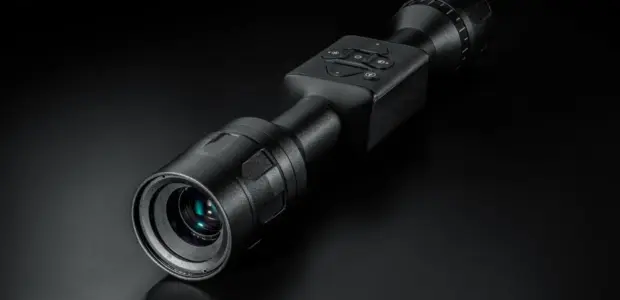

We have shortlisted the top 3 best thermal monoculars for hunting in 2026. These shortlisted products include something for every user and every budget by consolidating the expert reviews and customer feedback.
Thermal monocular devices are an excellent way of gaining better vision in dark or unclear conditions. These devices range wildly in terms of their price tags, specifications, features and other aspects.
Top 3 Best Thermal Monoculars for Hunting in 2026
#1. Pulsar Helion XP Thermal Monocular
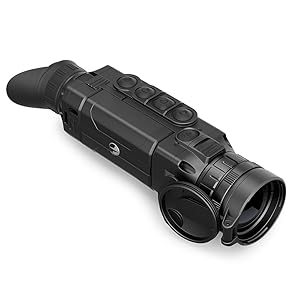
Pulsar Helion XP Thermal Monocular
Editors Rating: Pulsar company is known for producing cutting-edge thermal imaging and night vision products. This commitment to quality and performance can be seen in the Pulsar Helion XP thermal monocular as well.
The Pulsar Helion XP thermal monocular has topped our list of top 3 best thermal monoculars 2019. This is simply because it offers an unparalleled performance for its category.
Helion XP with 50Hz refresh rate – this enables you to attain excellent clarity of view when looking through this monocular.
It also features an integrated accelerometer. With a detection range of up to 1800 metres, the thermal monocular is great for all types of outdoor use.
Pulsar has used a 640x480px micro-bolometric matrix for the video recorder. With an onboard video storage of 8GB, the monocular offers plenty of space to capture the important moments during hunting, rescue and surveillance.
Helion XP is perfect for usage in a wide range of temperature, from minus 13 degree Celsius in the cold to up to 122 degrees. There is a choice of palettes for the users to choose a contrast that provides the best viewing experience in any given environment. The monocular offers good heat signature detection up to 2000 yards, making it a valuable gadget for hunters, rescue workers, law enforcement and other outdoor enthusiasts alike.
The body of the monocular features a rugged and durable design. It has been made to be dustproof, waterproof and fogproof. This makes it a dependable tool for a variety of weather conditions. The interface is incredibly easy and intuitive so that you can master it fairly quickly.
The power supply comprises of an 8-hour rechargeable battery. For its price, Helion XP is simply the best thermal monocular available on the market.
#2. ATN OTS-HD 384 Thermal Smart HD Monoculars
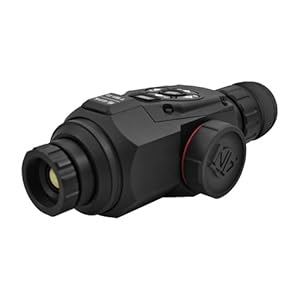
ATN OTS-HD 384 Thermal Smart HD Monoculars
Editors Rating: ATN is another manufacturer of thermal imaging products that has a global reputation. The company is trusted by thousands of hunters, law enforcement personnel and other customers.
The OTS-HD 384 Thermal Smart HD monocular from ATN is another excellent choice. The stand-out feature of this monocular is that it combines its thermal imaging capabilities with HD quality view.
ATN has provided a 384×288 pixel HD resolution for thermal imagery in this monocular.
This not only enables viewing in the dark or unclear conditions but also adds a layer of extra clarity and detail to the view.
OTS-HD includes a smart rangefinder which quickly measures distances with a dependable degree of accuracy. Once you achieve a clear view and know the distance, you can also narrow the focus on a particular object using the E-Zoom feature.
ATN has used Smooth Zoom technology which ensures that you are able to achieve an ultra-slow zooming when required.
You can use photo and video capture capabilities of this monocular to recording high-quality videos and photos. The Wi-Fi streaming feature also allows you to stream video and share the view from the monocular with friends and family.
Using a monocular outdoors, especially when you are on the move, can result in shaky photos or videos. To improve this aspect of the monocular, OTS-HD features a 3D Gyroscope. The gyroscope improves the stability of the view and ultimately results in images that are sharper and better.
#3. FLIR Scout TK Pocket-Sized Thermal Monocular
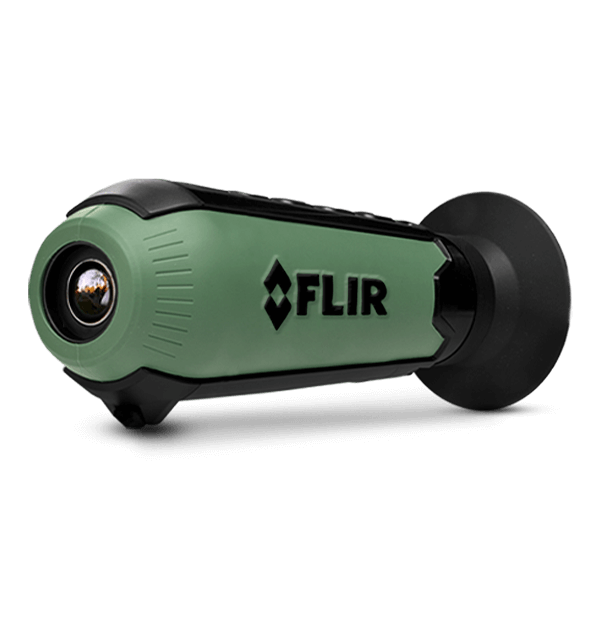
Editors Rating: If you are looking for a budget-friendly thermal monocular that offers all the essential basics, look no farther than the FLIR Scout TK. This incredibly handy, intuitive and convenient monocular is perfect for everyday casual use.
Scout TK offers good thermal detection for up to 100 yards. This makes it great for use in and around your home, during outdoor walks and for general visibility in unclear conditions.
It may not be perfect for hunting or professional surveillance, but it is great for day-to-day personal use. It boots up in less than 5 seconds and is ready to deliver practical thermal imaging.
The monocular has an incredibly light-weight design, weighing a mere 6 ounces. The compact and nifty design makes it easier for you to carry this monocular in your pocket.
It has a 640×480 LCD display and a resolution of 160×120. You can choose from a range of color palettes to pick one that gives you the best view. The power supply comprises of a 5-hour rechargeable Li-ion battery.
FLIR Scout TK is a great choice and comes with an unbelievably affordable price tag when compared to other basic thermal monoculars. For beginners, casual users and occasional enthusiasts of thermal imaging, this monocular is the perfect offering.
How to Choose a Best Thermal Monocular 2026
Many factors determine which thermal monocular is best for you. Most notably, it depends on the intended usage of the monocular. For instance, if you want to occasionally use the monocular for nighttime visibility at a farmhouse, you will need a different monocular than a law enforcement
personnel who may need it for surveillance and rescue operations.
Following are some of the key factors you should consider when choosing a thermal monocular:
Intended usage: How do you intend to use the monocular? Are you going to carry it and use it outdoors for extended hours on end? In such a case, you may require a monocular that has a light-weight profile while offering a good range of features. If you are going to use it for a few hours but need good detection range and crisper viewing capabilities, you can opt a heavier but more advanced model.
Depending on your usage as a hunter, law enforcement personnel, enthusiast, casual user or beginner, the best thermal monocular will depend on your requirements and goals.
Durability: Some thermal monocular models are made to be more durable and sturdy than others. Whether or not you need a sturdy model depends on your usage. If you are a hunter who has to scout, spot, view and run towards the game during outdoor excursions, you should choose a more durable monocular that can withstand the rough and tough usage. The same may apply to law enforcement use. If you are going to use it for casual, everyday security and viewing in the dark, you can get a more rudimentary basic which isn’t very sturdy.
Color Palettes: A wide range of color palettes are available when it comes to thermal monocular. Some models come with a single or dual palette option. Others feature multiple palettes. Color palettes allow you to see a view in different colors and contrast, giving you a better idea of the details and objects in the view. Hunters and law enforcement personnel may need more color palettes for clearer viewing capabilities. Most others users can make do with a black-and-white mode which can still deliver most of the vital details.
Ease of Use: In most cases, you will use a thermal monocular in time-sensitive situations. This particularly applies to rescue and surveillance personnel, as well as law enforcement members and hunters. A monocular with an intuitive interface is easier to use, even in urgent situations. One with a lot of buttons and hard navigation can become a hassle in difficult situations instead of offering any assistance. So you should always choose a monocular that offers easier navigation and use.
Difference Between Thermal and Night Vision Monocular
Thermal imaging and night vision essentially use two different technologies to achieve better viewing ability in dark or unclear conditions.
Thermal imaging basically relies on heat signature. A thermal sensor essentially detects the heat differences in a given view. It then generates a heat map where heat differences are shown in dual or multiple colors. As all living objects generate heat, thermal imaging is able to detect the presence of humans and animals easily. It can also detect heat generated from other sources.
In contrast, night vision uses ambient and available light to offer better visibility in the dark. It simply amplifies the available light to such a degree that you feel that even a dark scene or view is lit up. In the absence of any light source at all, night vision devices may not deliver a very good performance. In such situations, a thermal imaging device is more effective in mapping the objects within the field of view.
FAQ’s About Thermal Monocular’s
🔍 What does a thermal monocular do?
A thermal monocular is a handheld device that detects heat (infrared radiation) and turns it into a visible image.
- It doesn’t need light at all
- It shows temperature differences, not colors or fine detail
- Warm objects (people, animals) stand out against cooler backgrounds
👉 Think of it as “seeing heat,” not seeing normally.
🏆 What’s the best thermal monocular?
There’s no single “best”—it depends on use. But here’s what defines a top-tier one:
- High resolution (e.g., 640×480 sensor)
- Good detection range
- Sensitive sensor (NETD rating)
- Lens size (larger = longer range)
Popular high-end brands include Pulsar, FLIR, and AGM (general industry knowledge + confirmed performance factors).
👉 If you want, I can recommend specific models for your budget.
📏 How far can a thermal monocular see?
- Small/cheap units: 50–300 meters
- Mid-range: 500–1,000 meters
- High-end: 1–3 km detection range (ideal conditions)
⚠️ Important:
- “Detection” ≠ “identification”
- Real-world range is usually shorter due to weather, terrain, etc.
🐍 Can a thermal scope pick up a snake?
👉 Yes—but not always.
- Snakes do emit heat, so they can be detected
- BUT:
- If their temperature matches the ground → hard to see
- Recently sun-warmed snakes → much easier
🧱 Can thermal monoculars see through walls?
❌ No.
They only read surface temperature, not what’s behind objects.
⏳ How long will a thermal monocular last?
- Battery life: 4–10 hours per charge (typical)
- Device lifespan: 5–10+ years if well maintained
Depends on:
- Battery type
- Build quality
- Usage conditions
🛒 What to look for when buying one
Key factors:
- Resolution (clarity)
- Detection range
- Refresh rate (Hz) (smoothness)
- Lens size (mm) (range & zoom)
- Battery life
- Weight/ergonomics
- Weather resistance
👉 Most important: sensor quality + lens
⚖️ Is it illegal to use a thermal monocular?
- Generally: legal to own
- Restrictions may apply for:
- Hunting (especially at night)
- Weapon-mounted scopes
Laws vary by country/region.
👉 In many places, handheld monoculars are fine—but always check local laws.
☀️ Can thermal monoculars be used during the day?
✅ Yes—and they work just as well.
They don’t rely on light at all.
🪟 Do thermal monoculars work through glass?
❌ No.
Glass reflects infrared, so you’ll only see the temperature of the glass, not what’s behind it.
📱 Can my cell phone see infrared?
❌ Not by itself.
- Normal phone cameras can’t detect thermal IR
- You need attachments like FLIR or Seek
🪖 How do snipers avoid thermal imaging?
They don’t “turn invisible,” but they reduce detection by:
- Thermal camouflage (insulated suits, reflective layers)
- Breaking body outline (terrain, cover)
- Staying still (movement stands out)
- Using barriers (walls, thick materials)
- Matching ambient temperature
👉 Thermal sees heat differences—so reducing that difference is key.
🧠 Quick summary
- Thermal = heat detection, not X-ray vision
- Works in total darkness
- Can’t see through walls or glass
- Range can reach kilometers (high-end)
- Very powerful—but not magic
Finally
A huge range of thermal monocular devices are available in the market today. These range from budget- friendly models under $500 all the way to more advanced models that cost in the tens of thousands of dollars. The ultimate choice depends on your usage requirements, budget and needs.
However, if you are only a beginner or enthusiast who wants only the basic thermal imaging capabilities, FLIR’s Scout TK is a great choice. If you can make do with a slightly less advanced model which still offers a good set of features, you can choose the OTS-HD monocular from ATN. If you are someone who want all the modern and advanced thermal imaging features without dishing out the top buck, the Pulsar Helion XP is the perfect option for you.
Related Articles: Best Thermal Imaging Camera 2026